
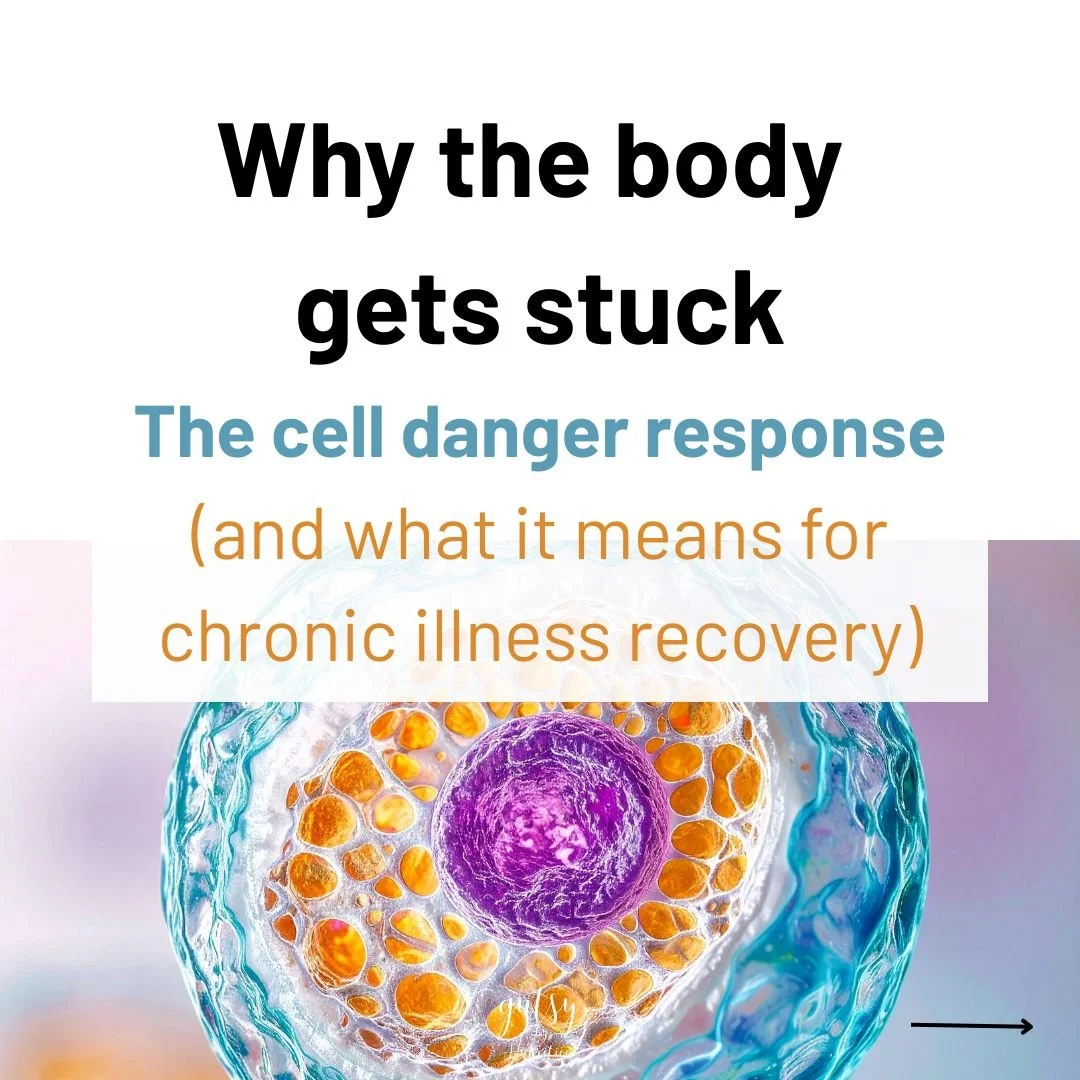
why the body gets stuck – the cell danger response (& what it means for chronic illness recovery)
You've done the work. The diet, the supplements, the protocols. Some things have helped — partially, temporarily. But something keeps pulling you back. The symptoms return. The reactivity persists. The body won't seem to finish healing.
If this sounds familiar, there may be a biological explanation that has nothing to do with effort or compliance — and everything to do with what the body's cells are doing underneath the surface.
It's called the cell danger response.
what is the cell danger response?
The cell danger response (CDR) is a concept developed by Dr Robert Naviaux at the University of California, San Diego. It describes a fundamental survival mechanism — a metabolic state that cells enter when they detect a threat.
That threat might be a pathogen, a toxin, physical injury, severe psychological stress, or any other signal the cell interprets as danger. In response, the cell shifts its priorities from normal function to defence and damage control.
In CDR, the cell
Reduces energy production — pulling resources away from normal cellular work
Releases chemical signals that alert neighbouring cells and the immune system
Tightens its membranes to prevent further invasion
Suppresses normal repair, growth, and regeneration
This is not dysfunction. It's brilliant, elegant survival biology. In an acute situation — an infection, an injury, a short-term stressor — the CDR activates, does its job, and then switches off when the threat has passed. The body completes the healing cycle and returns to normal.
The problem arises when the CDR doesn't switch off.
when healing gets stuck
In a healthy acute response, the sequence is: threat → CDR activates → threat resolves → CDR switches off → healing completes.
In complex chronic illness, that final step — CDR switches off — doesn't happen. The body remains in a state of metabolic defence rather than repair. Sometimes for months. Sometimes for years.
Dr Naviaux describes this as being "stuck in the first act" — the body is still in crisis mode, still waiting for a signal that the danger has passed, unable to move into the completion phase of healing.
This stuck CDR state has been identified in research across a remarkable range of conditions — ME/CFS, mould illness, long COVID, autoimmunity, PTSD, Lyme disease, and more. The common thread isn't the original trigger. It's the failure of the healing response to complete.
what keeps the CDR active?
Understanding what maintains the stuck state is the key to knowing how to address it.
ongoing low-grade triggers
Even after a primary stressor has been addressed, residual triggers can keep the CDR signalling danger. These might include persistent gut dysbiosis, low-grade infections that were never fully cleared, ongoing environmental exposures like mould, or nutritional deficiencies that impair cellular function. The cells are still receiving signals that the environment isn't safe.
mitochondrial dysfunction
The CDR is fundamentally a mitochondrial response — the mitochondria are the cellular structures that initiate and maintain it. When mitochondria are chronically stressed — by toxins, infections, nutrient deficiencies, or oxidative damage — they may remain in a defensive state even when the acute threat has resolved. Supporting mitochondrial recovery is therefore central to unwinding the CDR.
the nervous system connection
The CDR and the autonomic nervous system are deeply intertwined. A nervous system chronically locked in a threat response — whether from ongoing physical illness, unresolved trauma, or the accumulated stress of being unwell for years — maintains the biological signals that keep the CDR active.
This is one of the clearest mechanisms by which psychological and neurological factors have measurable physical effects in chronic illness. It also explains why nervous system work is not peripheral to physical recovery — it is part of it.
incomplete resolution of the original trigger
Sometimes the original cause of illness was never fully identified or addressed. Mould illness that wasn't recognised. A gut infection that was treated but not eradicated. A viral infection that left residual immune activation. When the original trigger remains — even at a subclinical level — the CDR has no reason to receive the "all clear."
the identity and belief layer
This is less commonly discussed but clinically significant. When someone has been unwell for a long time, the nervous system and subconscious mind can become conditioned to a state of threat and illness. Beliefs formed during prolonged illness — about safety, about what the body is capable of, about what recovery means — can maintain a physiological threat state that keeps the CDR active even when the physical drivers have been addressed.
This is part of why Psych-K can be a meaningful part of CDR recovery — not as a replacement for physical treatment, but as a way of addressing the subconscious signalling that can keep the body stuck.
what a complete approach looks at
Because the CDR can be maintained by multiple overlapping factors, recovery requires working across several layers simultaneously.
identify and address all active triggers
This means looking beyond the obvious. Not just the primary diagnosis — but the gut layer, the infection history, the environmental burden, the nutritional deficiencies that may be impairing cellular function. Each unaddressed trigger is a reason for the CDR to stay active.
support mitochondrial recovery
Targeted nutritional support for mitochondrial function — including CoQ10, B vitamins (particularly B1, B2, B3), magnesium, NAD precursors (in appropriate context — see the supplement considerations post), and antioxidant support. Reducing the mitochondrial burden of toxins and oxidative stress simultaneously.
nervous system regulation
Approaches that support the autonomic nervous system moving out of chronic threat response — including vagal nerve support, breathwork, somatic approaches, and where relevant, Psych-K to address the subconscious belief layer. This is not optional — it's part of the biological mechanism.
pacing and rest
The CDR actively suppresses energy production. Pushing through fatigue in a CDR-driven illness depletes the very resources the body needs for recovery. Pacing — genuinely working within energy limits rather than against them — is not giving up. It's working with the biology.
addressing the limbic system
In conditions like mould illness, long COVID, and ME/CFS, the limbic system — the brain's threat-detection centre — can become sensitised, maintaining a state of hypervigilance that perpetuates the CDR even after physical triggers are addressed. Limbic retraining approaches, alongside the physical work, can be meaningful here.
patience with the process
Because the CDR can maintain a stuck state for years, unwinding it takes time. Recovery is rarely linear. There are often periods of improvement followed by setbacks — not because healing is failing, but because cellular signalling that was frozen for a long time is gradually thawing. Understanding this reduces the despair that accompanies setbacks and supports the sustained effort recovery requires.
what this means for you
If you've been doing the right things and still feel like something is keeping you from finishing the healing process — this framework may be the missing explanation.
The body is not failing to heal out of stubbornness or some mysterious unknowable reason. It is responding logically to signals it's receiving — signals that say the danger hasn't passed yet.
The work of recovery, in this framework, is about changing those signals. Removing the remaining triggers. Supporting the cellular machinery that does the healing. Calming the nervous system that's maintaining the alert. And sometimes, addressing the deeper layers of belief and identity that are keeping the threat response alive.
Recovery is possible. The body's default state is health. Sometimes it simply needs the right conditions — and enough time — to find its way back.
Nore Hoogstad is a Functional Nutritionist & Psych-K Practitioner specialising in complex, unresolved health cases. A free 20-minute call is available to share your story and explore what might be driving your symptoms. Book here.