
Is leaky gut driving your histamine intolerance?
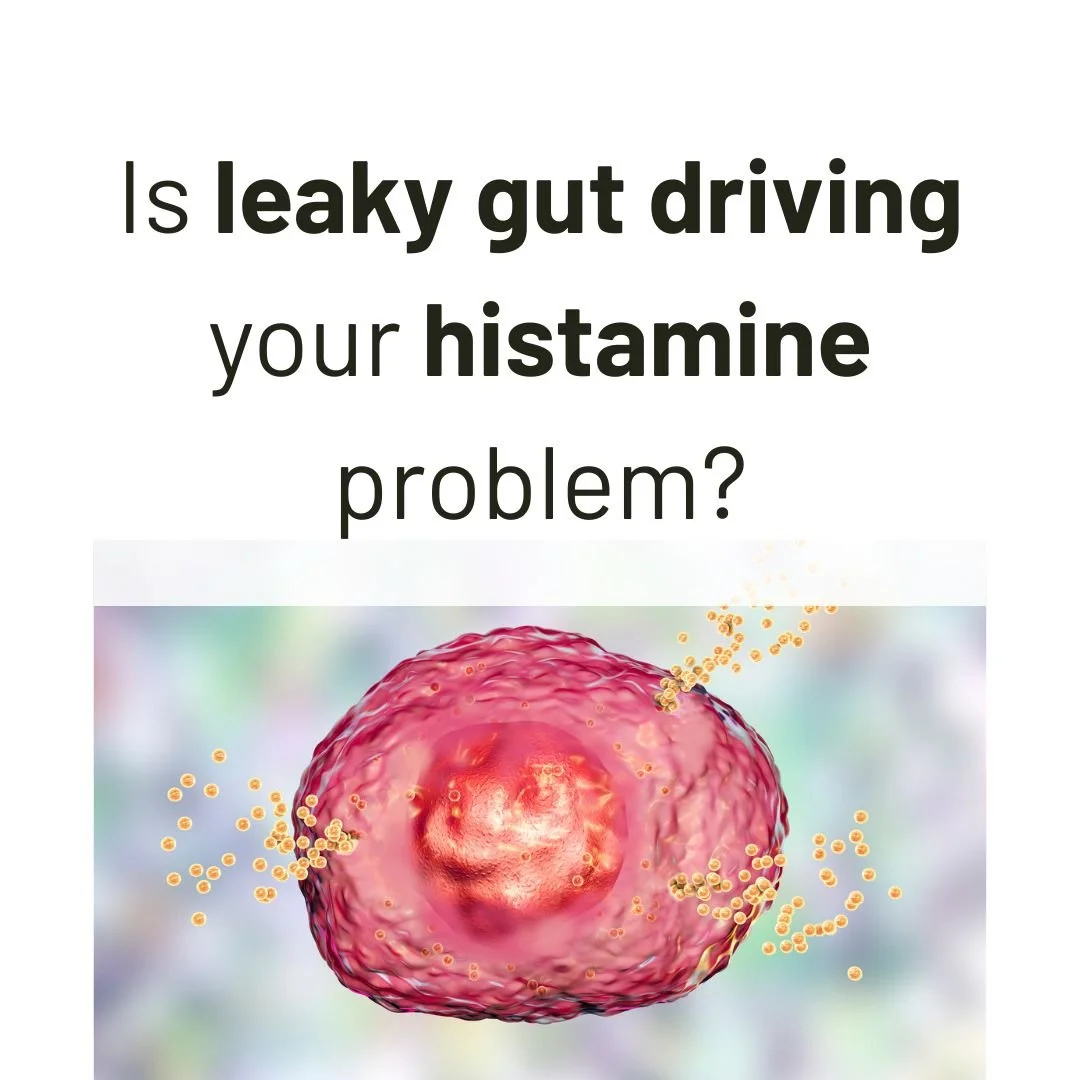
Is leaky gut driving your histamine intolerance?
If histamine intolerance is on your radar - whether newly discovered or something you've been managing for years - there's a good chance you've already overhauled your diet. No wine, no aged cheese, no leftovers, no fermented foods. And yet the headaches, flushing, hives, or racing heart keep showing up.
For many people, the diet is only part of the answer. The gut - specifically its integrity and its microbial balance - plays a central role in how much histamine reaches your bloodstream in the first place.
what is histamine intolerance, & why does it develop?
Histamine is a chemical the body produces naturally. It's involved in immune responses, digestion, and even neurotransmitter signalling. In normal amounts, it's essential. Problems arise when histamine accumulates faster than the body can break it down.
This breakdown depends primarily on two enzymes - diamine oxidase (DAO) and histamine N-methyltransferase (HNMT). DAO works in the gut; HNMT works inside cells throughout the body. When either enzyme is depleted or blocked, histamine builds up.
Common symptoms of histamine excess include:
Headaches or migraines
Skin flushing, hives, or itching
Runny nose or sinus congestion (unrelated to colds)
Heart palpitations or racing pulse
Digestive cramping, bloating, or diarrhoea
Anxiety, insomnia, or irritability
Menstrual pain or cycle irregularities
What makes histamine intolerance particularly frustrating is how wide-ranging and seemingly unrelated these symptoms can be - and how easily they're attributed to other conditions.
the gut's role in histamine regulation
The gut is not simply a passive tube through which food and histamine travel. It's an active site of histamine production, breakdown, and absorption - and its condition determines how well any of those processes work.
Histamine is produced in the gut itself
Certain bacteria naturally produce histamine as a byproduct of fermentation. In a balanced microbiome, histamine-producing bacteria are kept in check by histamine-degrading bacteria. When dysbiosis is present - an imbalance in gut flora - histamine-producing strains can dominate, flooding the gut with histamine before it's even absorbed from food.
DAO is produced in the gut lining
The enzyme most responsible for breaking down dietary histamine - DAO - is produced by the cells lining the small intestine. This is significant, because anything that damages or inflames the gut lining will directly reduce DAO production. Less DAO means less histamine breakdown - regardless of how carefully food is chosen.
Leaky gut opens the floodgates
In a healthy gut, the tight junctions between intestinal cells act as a selective barrier - allowing nutrients through while keeping larger molecules, pathogens, and irritants out.
When intestinal permeability increases - through inflammation, gut infections, dysbiosis, mould exposure, chronic stress, gluten sensitivity, or other triggers - those tight junctions loosen. Histamine that would normally be broken down or excreted can now pass directly into the bloodstream in far greater quantities.
This is the core mechanism that many histamine intolerance protocols miss. The problem isn't only the amount of histamine coming in - it's the gut's reduced capacity to contain and break it down.
how leaky gut & histamine reinforce each other
This is where things get clinically interesting - and where people tend to get stuck.
Histamine itself increases intestinal permeability. So leaky gut allows more histamine through, and that histamine then makes the gut more permeable - creating a self-perpetuating cycle that dietary restriction alone rarely breaks.
Add to this that histamine triggers mast cells, which release further inflammatory mediators, which further inflame the gut lining. In people with mast cell activation patterns, this cycle can become deeply entrenched.
patterns that may suggest this connection
The following aren't diagnostic criteria - rather, they're patterns that often appear together in people navigating this intersection:
Histamine symptoms that persist despite a strict low-histamine diet
Symptoms that worsen during or after periods of high stress
A history of gut infections, SIBO, Candida, or antibiotic use
Mould or water-damaged building exposure in the history
Worsening reactions to fermented foods over time, rather than improving
Symptoms that began or intensified after a gut illness or food poisoning
Co-existing conditions like MCAS, endometriosis, or autoimmunity
what a more complete approach looks at
Because the gut-histamine connection runs in multiple directions, addressing it effectively means working on several things at once rather than in sequence.
Reducing intestinal permeability - identifying and removing what's driving the gut inflammation, whether that's dysbiosis, a stealth infection, mould, food sensitivities, or nervous system dysregulation. Healing the gut lining through targeted nutrition and support.
Rebalancing the microbiome - reducing histamine-producing bacterial strains while supporting histamine-degrading ones. Specific strains of Lactobacillus rhamnosus and Bifidobacterium infantis have been shown to support DAO activity and reduce histamine load - in contrast to some strains (like certain Lactobacillus casei strains) which can worsen histamine symptoms. Probiotic choice in this context genuinely matters.
Supporting DAO production - through nutrients that cofactor DAO activity, including vitamin B6, copper, and vitamin C, alongside gut lining repair. Some people also benefit from DAO enzyme supplementation as a short-term bridge - not a long-term solution.
Addressing the mast cell layer - particularly where histamine reactions seem disproportionate or widespread. Mast cell stabilisation through diet, specific supplements, and nervous system support can help interrupt the inflammatory cascade.
Pacing the approach - because healing the gut while managing histamine symptoms simultaneously requires careful sequencing. Some gut-healing interventions (like certain probiotics or fermented foods) can temporarily worsen histamine symptoms. Working with someone who understands this intersection matters.
the bigger picture
Histamine intolerance is rarely a standalone issue. In complex chronic health cases, it frequently overlaps with oxalate sensitivity, mould illness, MCAS, gut dysbiosis, and hormonal imbalances - particularly in the context of oestrogen, which upregulates histamine receptors and is itself degraded by DAO.
This is why histamine symptoms often worsen in the second half of the menstrual cycle, during perimenopause, or with oestrogen dominance - and why addressing histamine without considering the hormonal picture often delivers incomplete results.
Understanding these overlaps - rather than treating each symptom in isolation - is often what finally moves the needle.
Nore Hoogstad is a Functional Nutritionist specialising in complex, unresolved health cases. If histamine intolerance, gut dysfunction, or overlapping chronic symptoms are part of the picture, a free Chronic Symptom Review is available here.