
Calcium stealing — why you body's acidity quietly weakens your bones
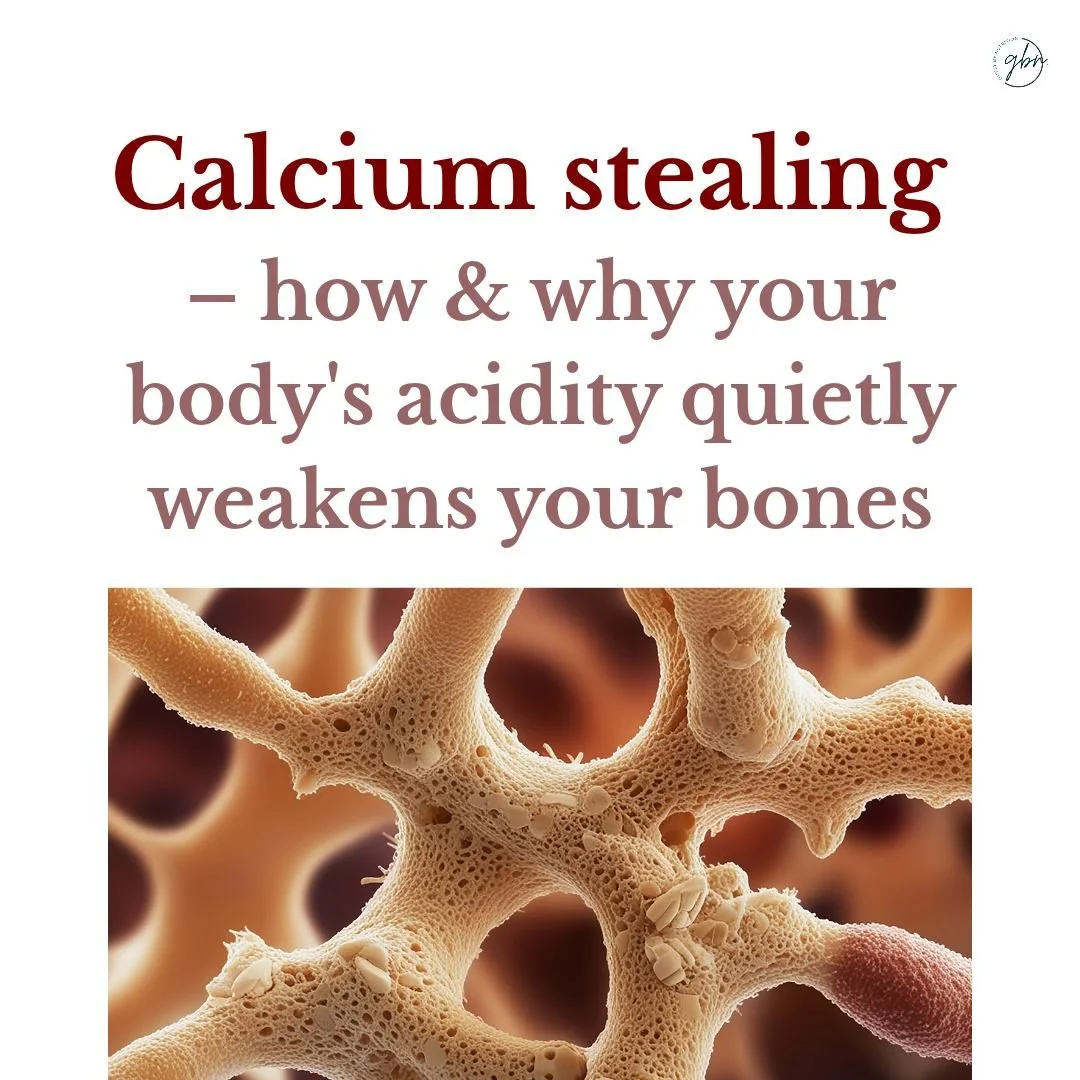
Bone is not just scaffolding. It's your body's buffer reserve — and most women have never been told that.
Here's how bone buffering works
Your blood pH is defended ferociously by your body, because it’s vital. When your internal environment drifts towards acidity and there aren't enough buffers coming in from diet and metabolism, your body draws on alkaline minerals from bone — calcium carbonate and calcium phosphate — to neutralise the acid.
The fact that our skeleton acts as an extracellular buffer in metabolic acidosis is well established in the physiology literature, and the mechanism is specific – acid dissolves bone hydroxyapatite and releases calcium and phosphate salts into circulation to mop up the excess hydrogen ions.
Why the body does this
That's not a fault. It's a survival mechanism, and a sensible one. Blood pH matters more than bone density. Your body will always choose the former.
The trade-off is real, though. Acid buffering leads to loss of bone density, which is why metabolic acidosis is associated with increased fracture risk. The skeleton is doing the job asked of it – but it's paying for it in mineral.
What happens to our bones over the years
Over time, the borrowing adds up. Bone mineral density declines. Bone becomes more porous and more fragile.
And the calcium that's been released has to be cleared by the kidneys — which is one reason a high acid load is associated with kidney stone risk. Low-grade metabolic acidosis has been proposed as a driver of calcium-oxalate stone formation, and increasing dietary bicarbonate may improve it.
This is a slow, cumulative process. It isn't caused by one acidic meal; it's driven by a chronic dietary acid load and low-grade metabolic acidosis sustained over years. Which is exactly why it's so easy to miss.
What the research shows
The observational evidence is mixed and more suggestive rather than settled.
A systematic review and meta-analysis of dietary acid load and bone health found associations with bone mineral density and fracture risk in adults. A more recent meta-analysis of observational studies reported increased fracture risk with higher dietary acid loads. Another meta-analysis found a high acidity potential diet was not associated with fracture risk but was associated with slightly lower bone mineral density.
And one study found that high dietary acid load was not associated with lower bone mineral density — but with an important caveat: sufficient calcium intake might neutralise this effect. A caveat is that we need sufficient levels of stomach acid (which is mineral and B vitamin dependent), other minerals, vitamins like D3 and K2, and digestive enzymes for calcium breakdown and utilisation, not to mention healthy inflamed cells.
Why ‘just take more calcium’ doesn't necessarily fix this
If the acid load is still high, that calcium gets used as buffer rather than laid down as bone. You're topping up the reserve while the drain stays open.
That's the mechanism the McLean finding points at from the other direction — enough calcium can offset the acid load, which means the two are in conversation with each other, not independent. Feeding the reserve helps. But if the drain is still running, you're feeding it faster than it empties, not closing it.
So what helps?
Two things, done together.
First, diet reduces what acidifies us – eat more alkalising foods, fewer of the things driving the load. This is the lever the intervention research points at: alkaline supplementation and reducing acid load have been studied specifically for their effect on bone mineral density at the hip and femoral neck.
Second, SANUM (German isopathic medicine) supports your own buffering systems — the alkalising and metabolic products, and the terrain support underneath, so your body isn't forced to raid the skeleton to stay safe.
Then calcium can go where it belongs. Into bone.
Top 10 alkalising foods
Ranked by potential renal acid load (PRAL) — the measure that actually reflects acid or base load on the body, not the taste of the food. Negative PRAL = base-forming (a good thing).
1. Spinach (cooked) · PRAL around −14 per 100 g The strongest base-former in the vegetable world. Cooked, not raw — oxalates drop and you get more of the minerals
2. Silverbeet / Swiss chard · similar to spinach, and easier to grow in Australia
3. Beetroot · strongly negative PRAL. Also supports bile flow and nitric oxide — useful if you're working on clearance as well as load
4. Kale · negative PRAL. Dense in calcium and vitamin K, which is the pairing that matters for bone
5. Broccoli · negative PRAL. One of the few vegetables that's both base-forming and well tolerated by many sensitive guts
6. Celery · negative PRAL. High water content, gentle, and a good juice base
7. Cucumber · negative PRAL. Mild, hydrating, and doesn't aggravate histamine or salicylate sensitivity the way many vegetables do
8. Zucchini · negative PRAL. Low-reactivity and easy to hide in just about anything
9. Avocado · negative PRAL. Fat plus base-forming minerals — one of the few fruits included here
10. Lemon and lime · negative PRAL despite tasting acidic. Citric acid metabolises to bicarbonate. This is the one that confuses people, and it's the most useful one to explain to clients
Veggie juices
Juicing concentrates base-forming minerals, which is why it works. I recommend it as a helpful tool, but it also strips the fibre that slows the sugar down. So the recommendation is vegetable-dominant, fruit as a seasoning, not the base. And pair with food if you have blood sugar regulation issues.
Green base — cucumber, celery, spinach, a wedge of lemon, small piece of ginger. Mild, base-forming, well tolerated
Beet and carrot — beetroot, carrot, celery, lemon. Sweeter, so keep the carrot to a third
Cabbage and celery — cabbage, celery, cucumber, parsley. Cabbage is underrated here and very gentle on the gut
Two cautions: Spinach and beetroot are high in oxalate, so if someone has a history of calcium-oxalate stones — which is exactly the population this whole topic covers — go easy on those two and lean on cucumber, celery, cabbage and zucchini instead. And have juice on a stomach that isn't empty if there's any reflux picture.
The bottom line
Your bones are doing a job nobody told you they had, and they'll keep doing it for as long as the environment requires them to. The work isn't to force more minerals in. It's to change the conditions that make the borrowing necessary.
Research sources
1. Gholami F, et al. (2022). Dietary Acid Load and Bone Health: A Systematic Review and Meta-analysis. — https://pmc.ncbi.nlm.nih.gov/articles/PMC9120865/
2. McLean RR, et al. (2011). Dietary Acid Load Is Not Associated with Lower Bone Mineral Density.Journal of Nutrition. — https://jn.nutrition.org/article/S0022-3166(22)02558-5/fulltext
3. Bushinsky DA, et al. (2022). Effects of acid on bone. — https://pmc.ncbi.nlm.nih.gov/articles/PMC9133222/
4. Salcedo-Betancourt JD, et al. (2024). The Effects of Acid on Calcium and Phosphate Metabolism. — https://pmc.ncbi.nlm.nih.gov/articles/PMC10889523/
5. DiNicolantonio JJ, et al. (2021). Low-grade metabolic acidosis as a driver of chronic disease.Open Heart. — https://openheart.bmj.com/content/8/2/e001730
*6. Effect of Acid or Base Interventions on Bone Health: A Systematic Review, Meta-Analysis, and Meta-Regression. — https://www.sciencedirect.com/science/article/pii/S2161831322001545